
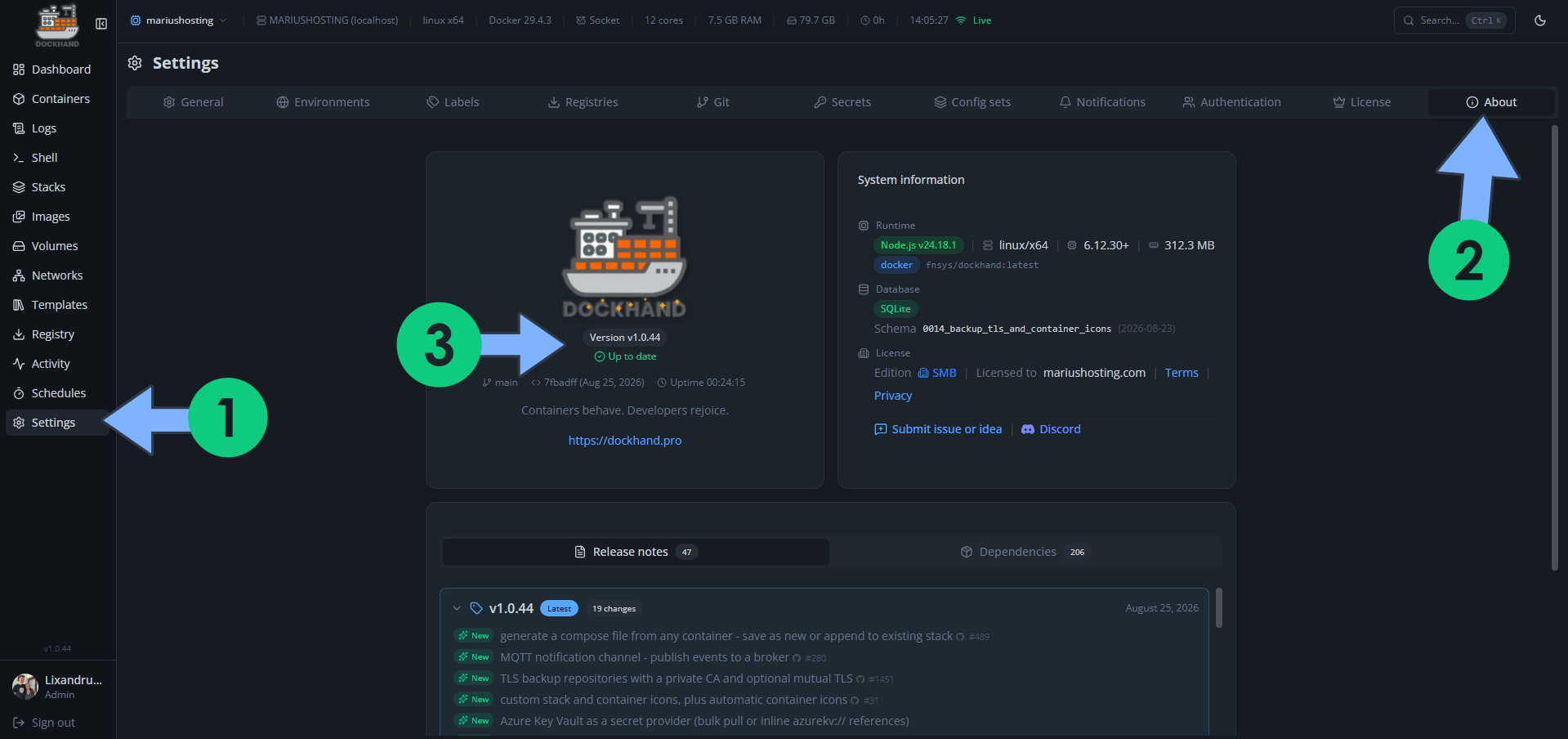
On August 25, 2026, Dockhand switched from version 1.0.43 to the new 1.0.44 version. Dockhand fixes the following issues and adds new options:
New – Generate a compose file from any container – save as new or append to existing stack
New – MQTT notification channel – publish events to a broker
New – TLS backup repositories with a private CA and optional mutual TLS
New – Custom stack and container icons, plus automatic container icons
New – Azure Key Vault as a secret provider (bulk pull or inline azurekv:// references)
New – Proton Pass inline references accept vault and item names, not just ids (pass://vault/item/field)
New – Branch selector on git stack, with per-stack branch override
New – Click the update icon in the image column to update a container
New – Pushover notifications can target specific devices
New – Keep specific images from being pruned with a dockhand.prune=false label
Fix: Infisical secret references now resolve to their value instead of the raw reference
Fix: The version-update dialog no longer duplicates the old tag when the running image is digest-pinned
Fix: A compose stack with a restarting container now shows a Stop action instead of Start
Fix: Optimize 1Password API calls on deploy
Fix: Direct-remote staging pulls the alpine helper image instead of failing when it’s missing
Fix: Proton Pass secrets now resolve on headless hosts with no system keyring
Fix: Fix switching an Infisical provider back to a static token
Fix: Fix backpressure in Docker streaming responses
Fix: Sort IPv6 subnets and addresses numerically instead of randomly
📋Install Dockhand 1.0.44 On Your Synology NAS
🔄How to Update Dockhand to Version 1.0.44 on Synology NAS
🔄How to Update Dockhand to Version 1.0.44 on UGREEN NAS
📋Install Dockhand 1.0.44 On Your Asustor NAS
🔄How to Update Dockhand to Version 1.0.44 on Asustor NAS
⚡How to Move Your Docker Containers From Portainer to Dockhand
🚀Farewell to 7 Docker Tools: Dockhand Just Killed Them All in One Go

🌟Starring projects like Dockhand on GitHub is a quick way to thank developers for their work. It boosts visibility so more people discover it, attracts contributors, and motivates the team to keep improving it.
What is Dockhand? Dockhand allows you to easily manage your different Docker environments. Dockhand is a modern, self-hosted Docker management platform with an intuitive web interface for homelabs, small businesses, and enterprises. It simplifies container operations, stack deployments, and observability through real-time management (start/stop/restart containers, web terminals, file transfers), a visual Compose editor, GitOps auto-sync, metrics, logs, OIDC/SSO, MFA, vulnerability scans, and multi-host support via the open-source Hawser agent. You can deploy it quickly as a Docker container with no cloud dependencies or telemetry. It’s forever free for personal use.
This post was updated on Saturday / October 17th, 2026 at 12:21 AM