
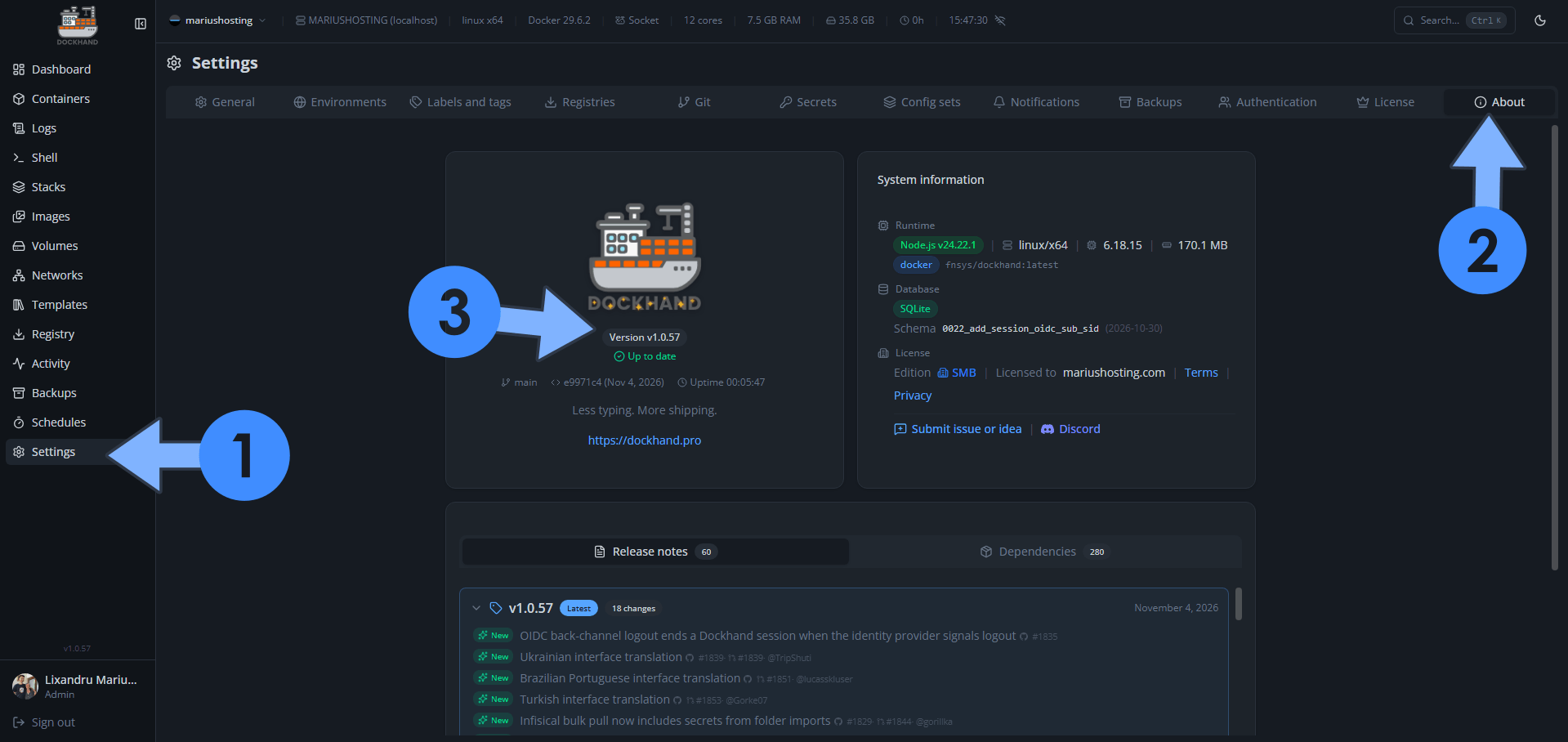
On November 4, 2026, Dockhand switched from version 1.0.56 to the new 1.0.57 version. Dockhand fixes the following issues and adds new options:
New – OIDC back-channel logout ends a Dockhand session when the identity provider signals logout
New – Ukrainian interface translation
New – Brazilian Portuguese interface translation
New – Turkish interface translation
New – Infisical bulk pull now includes secrets from folder imports
New – Convert a stack between local and git management without recreating it
Fix: Git stack files keep their executable bit when deployed to a Hawser remote host
Fix: A git stack webhook skips a push whose branch is not the one the stack tracks
Fix: The containers and stacks status filter survives a page refresh
Fix: Git stack files over 10 MB reach a Hawser agent instead of being dropped
Fix: Env vars used only as placeholders in other env values are no longer flagged unused
Fix: Update bundled dependencies (nodemailer, undici)
Fix: Detect a same-version rebuild of a floating multi-arch tag by the image the container actually runs
Fix: Stop sending a container exit notification for a non-terminating signal like a terminal resize
Fix: View and download container files whose names contain characters like { } or =
Fix: Always show the file action buttons on touch devices
Fix: Widen the edit-backup dialog so bind-mount paths are not cut off, with the full path on hover
Fix: Security hardening: path-write guards, deploy-env filtering, origin checks and framing headers
📋Install Dockhand 1.0.57 On Your Synology NAS
🔄How to Update Dockhand to Version 1.0.57 on Synology NAS
🔄How to Update Dockhand to Version 1.0.57 on UGREEN NAS
📋Install Dockhand 1.0.57 On Your Asustor NAS
🔄How to Update Dockhand to Version 1.0.57 on Asustor NAS
⚡How to Move Your Docker Containers From Portainer to Dockhand
💡Note: How to Free Disk Space on Your NAS if You Run Docker and Dockhand
🚀Farewell to 7 Docker Tools: Dockhand Just Killed Them All in One Go

🌟Starring projects like Dockhand on GitHub is a quick way to thank developers for their work. It boosts visibility so more people discover it, attracts contributors, and motivates the team to keep improving it.
What is Dockhand? Dockhand allows you to easily manage your different Docker environments. Dockhand is a modern, self-hosted Docker management platform with an intuitive web interface for homelabs, small businesses, and enterprises. It simplifies container operations, stack deployments, and observability through real-time management (start/stop/restart containers, web terminals, file transfers), a visual Compose editor, GitOps auto-sync, metrics, logs, OIDC/SSO, MFA, vulnerability scans, and multi-host support via the open-source Hawser agent. You can deploy it quickly as a Docker container with no cloud dependencies or telemetry. It’s forever free for personal use.
This post was updated on Wednesday / November 4th, 2026 at 7:30 PM