
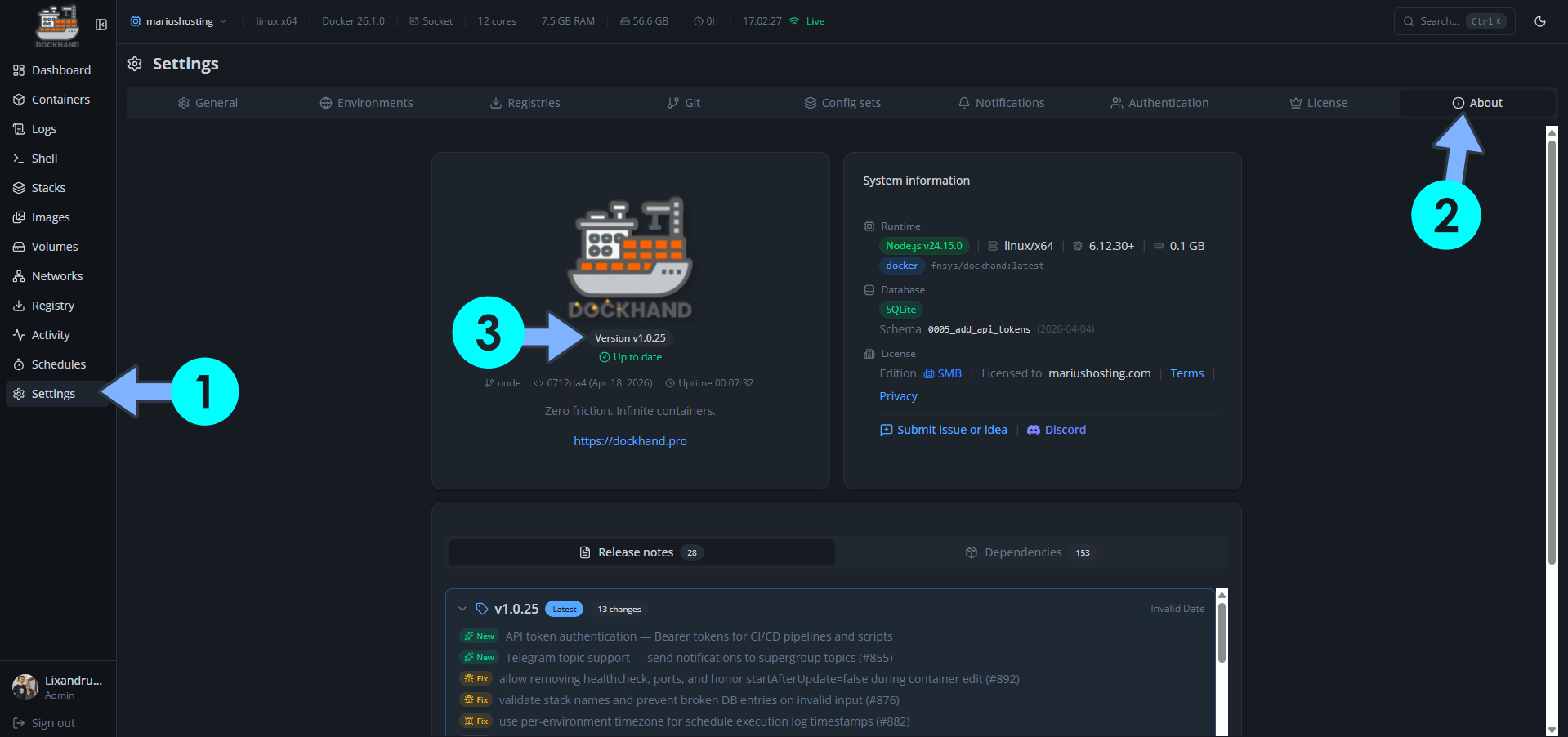
On April 18, 2026, Dockhand switched from version 1.0.24 to the new 1.0.25 version. Dockhand fixes the following issues and adds new options:
New – API token authentication – Bearer tokens for CI/CD pipelines and scripts
New – Telegram topic support – send notifications to supergroup topics
Fix: Allow removing healthcheck, ports, and honor startAfterUpdate=false during container edit
Fix: Validate stack names and prevent broken DB entries on invalid input
Fix: Use per-environment timezone for schedule execution log timestamps
Fix: “Pull image before update” and “Start after update” settings ignored
Fix: Image prune timeout on hawser-standard when pruning many images
Fix: Bump Docker Compose to 5.1.2
Fix: Mask secret environment variables in container inspect modal
Fix: Viewer role can toggle, delete, and run schedules
Fix: Settings show defaults instead of saved values after login until page refresh
Fix: Settings toggle notifications show wrong state
Fix: Stack memory tooltip shows inflated total on multi-container stacks
📋Install Dockhand 1.0.25 On Your Synology NAS
🔄How to Update Dockhand to Version 1.0.25 on Synology NAS
🔄How to Update Dockhand to Version 1.0.25 on UGREEN NAS
📋Install Dockhand 1.0.25 On Your Asustor NAS
🔄How to Update Dockhand to Version 1.0.25 on Asustor NAS
⚡How to Move Your Docker Containers From Portainer to Dockhand
🚀Farewell to 7 Docker Tools: Dockhand Just Killed Them All in One Go

🌟Starring projects like Dockhand on GitHub is a quick way to thank developers for their work. It boosts visibility so more people discover it, attracts contributors, and motivates the team to keep improving it.
What is Dockhand? Dockhand allows you to easily manage your different Docker environments. Dockhand is a modern, self-hosted Docker management platform with an intuitive web interface for homelabs, small businesses, and enterprises. It simplifies container operations, stack deployments, and observability through real-time management (start/stop/restart containers, web terminals, file transfers), a visual Compose editor, GitOps auto-sync, metrics, logs, OIDC/SSO, MFA, vulnerability scans, and multi-host support via the open-source Hawser agent. You can deploy it quickly as a Docker container with no cloud dependencies or telemetry. It’s forever free for personal use.
This post was updated on Saturday / October 17th, 2026 at 12:42 AM