
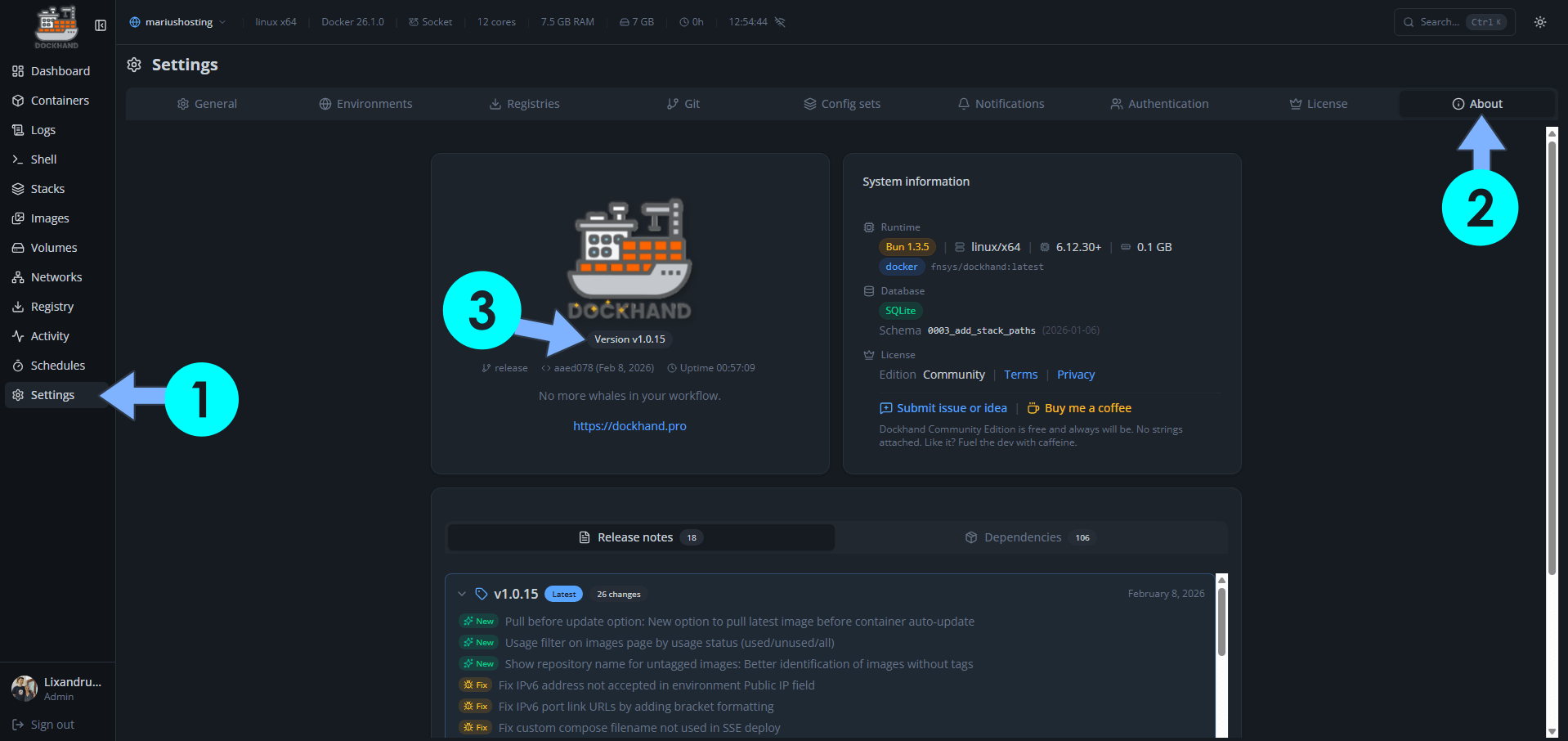
On February 8, 2026, Dockhand switched from version 1.0.14 to the new 1.0.15 version. Dockhand fixes the following issues and adds new options:
New – Sort vulnerability scan results by severity by default
New – Pull before update option: New option to pull latest image before container auto-update
New – Usage filter on images page by usage status (used/unused/all)
New – Show repository name for untagged images: Better identification of images without tags
New – Copy button for compose file contents in stack modal
New – Confirmation dialog before git stack sync
Fix: IPv6 address not accepted in environment Public IP field
Fix: IPv6 port link URLs by adding bracket formatting
Fix: Custom compose filename not used in SSE deploy
Fix: Env var leakage from Dockhand to user stacks
Fix: SMTP notification test returning false success
Fix: Custom compose file path ignored for Hawser git stack deployments
Fix: Escaped $ variables (Docker Compose syntax) incorrectly flagged as missing
Fix: Native compose pull and up when updating stack containers
Fix: Vulnerability scans hanging indefinitely or failing with JSON parse errors
Fix: Fix memory leaks in SSE event streams and unconsumed Docker API response bodies
Fix: Timezone aliases (e.g. Europe/Kyiv) not saving correctly
Fix: Login crash with large session timeout values
Fix: Profile display name not persisting due to field name mismatch
Fix: Date formatting not respecting user preferences
Fix: Static IP not preserved during container auto-update
Fix: Stack adoption path conflict across different environments
Fix: Container auto-update causing permission denied on bind mounts
Fix: Health tab not showing healthcheck configuration
Fix: Stack custom paths reset after edit
Fix: Autofocus on login username and MFA code fields
📋Install Dockhand 1.0.15 On Your Synology NAS
🔄How to Update Dockhand to Version 1.0.15 on Synology NAS
🔄How to Update Dockhand to Version 1.0.15 on UGREEN NAS
📋Install Dockhand 1.0.15 On Your Asustor NAS
🔄How to Update Dockhand to Version 1.0.15 on Asustor NAS
⚡How to Move Your Docker Containers From Portainer to Dockhand
What is Dockhand? Dockhand allows you to easily manage your different Docker environments. Dockhand is a modern, self-hosted Docker management platform with an intuitive web interface for homelabs, small businesses, and enterprises. It simplifies container operations, stack deployments, and observability through real-time management (start/stop/restart containers, web terminals, file transfers), a visual Compose editor, GitOps auto-sync, metrics, logs, OIDC/SSO, MFA, vulnerability scans, and multi-host support via the open-source Hawser agent. You can deploy it quickly as a Docker container with no cloud dependencies or telemetry. It’s forever free for personal use.
This post was updated on Saturday / October 17th, 2026 at 11:48 AM