

You’re almost certainly using HTTP every single day without thinking about it. Every time you open Google, visit this site, or load any webpage, your browser and the server are speaking HTTP the protocol that moves web content around. HTTP has been around a long time. The first official version (0.9) appeared in 1991. For many years the web ran on HTTP/1.1, a solid but increasingly limited protocol. In 2015, HTTP/2 arrived to fix many of those limitations. One of its main goals is simple: reduce latency and make pages load faster.
Here’s what HTTP/2 actually improves on your server or NAS:
- Faster connection setup between browser and server.
- More efficient use of a single connection.
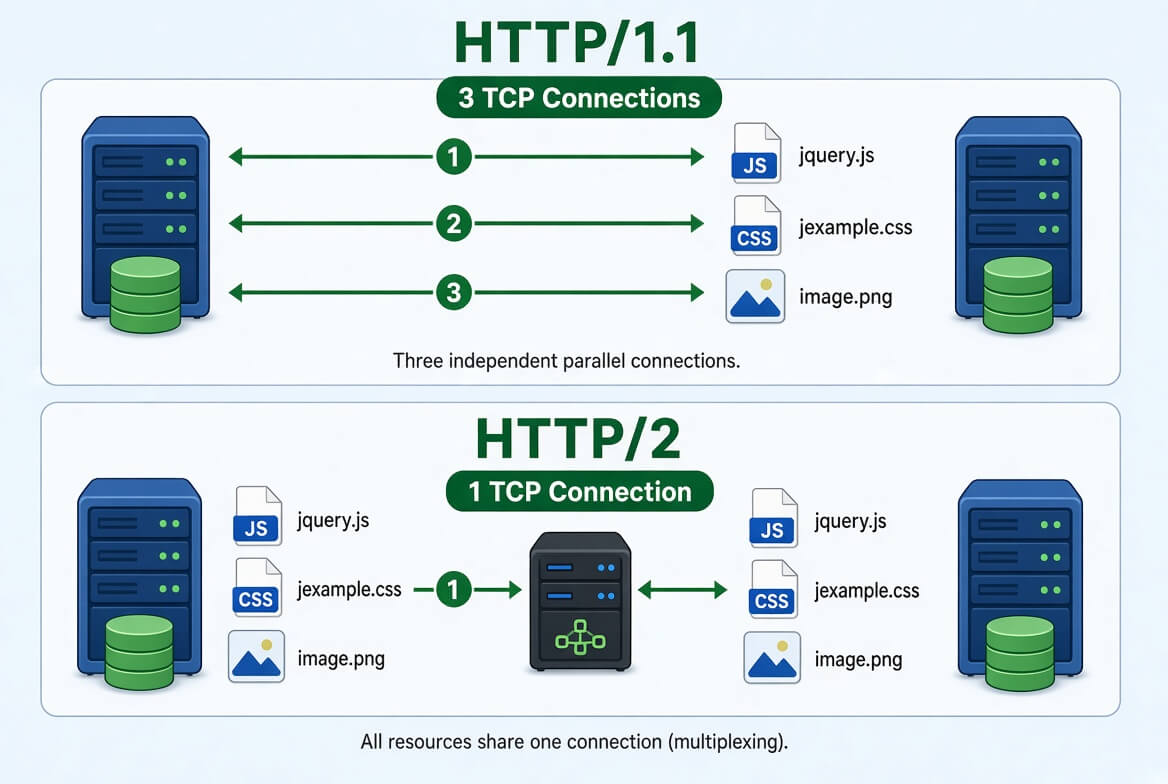
- Multiple files can be transferred at the same time (multiplexing) instead of one after another.
- Server Push. The server can send resources it knows the browser will need before the browser even asks for them.
In short, HTTP/2 is a smarter, more efficient way of delivering the same website components. The difference is especially noticeable when a page needs many small files (CSS, JavaScript, images, etc.). (You can see a clear visual comparison of HTTP/1.1 vs HTTP/2 in the diagram image below.)
💡Good news: Synology has supported HTTP/2 since DSM 6.0, and it’s very easy to turn on.
- Open Control Panel.
- Go to Network / Connectivity tab.
- Check the box Enable HTTP/2.
- Click Apply.
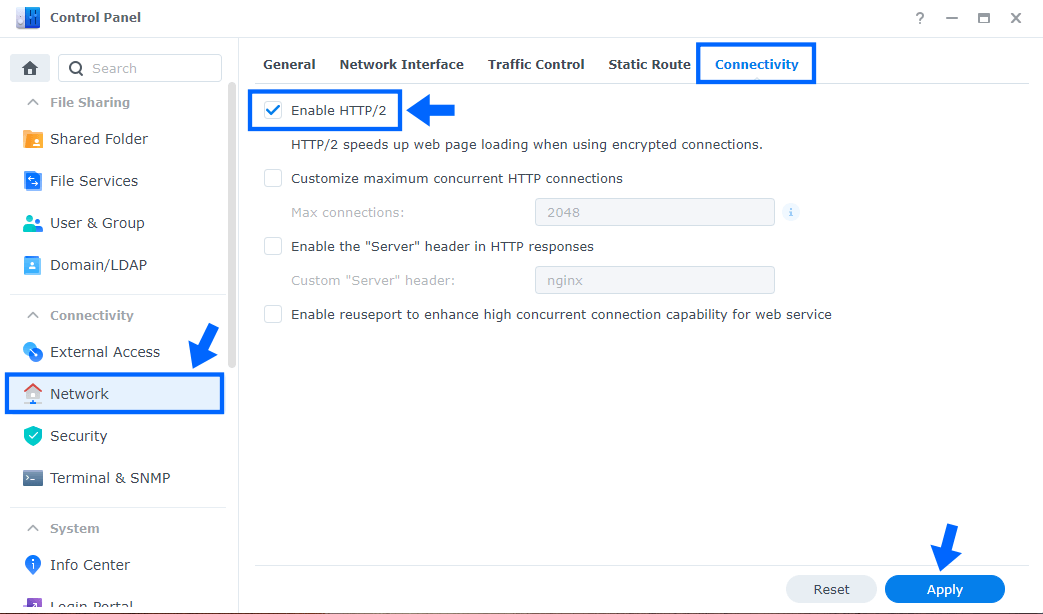
That’s it. Your NAS will now serve web traffic over HTTP/2 (when the client also supports it, which almost every modern browser does).
Yes, but not because of WordPress itself. HTTP/2 works at the web-server level. Once it’s enabled on your Synology NAS, every site running on it (WordPress, Ghost, static sites, etc.) benefits automatically. For WordPress specifically, you can go a step further with server-push plugins that tell the server which CSS and JavaScript files to push early. The combination of HTTP/2 + smart pushing often gives a noticeable improvement in page-load times.
A quick personal note: I first enabled HTTP/2 on my own DS920+ a couple of years ago when I was trying to squeeze better performance out of a moderately busy WordPress site where mariushosting dot com was live. The difference wasn’t dramatic on a single page with few assets, but on pages that loaded 15–20 small files the improvement was clear especially on mobile connections. Load times dropped, and the site just felt snappier. It’s one of those “set it and forget it” optimisations that quietly makes everything better with almost zero ongoing cost. If you’re still on HTTP/1.1, I’d recommend flipping the switch. It takes less than a minute and there’s really no downside.
This post was updated on Saturday / October 10th, 2026 at 10:01 PM